

 |
| If you look closely, you can see a couple hikers on their way to the floor of the crater |


 |
| Little Ubehebe Crater nearby |

 |
| The start of the road to the Racetrack dry lake, 23 grueling miles away |


|
| If you look closely, you can see a couple hikers on their way to the floor of the crater |
|
| Little Ubehebe Crater nearby |
|
| The start of the road to the Racetrack dry lake, 23 grueling miles away |
 |
| Our campsite at Mesquite Spring overlooking a wash |
 |
| A view of our campground from the bluff behind us. If you look real close at the center of the photo, you can see our trailer with it's dark rear window. This place was truly in the middle of nowhere. |

 |
| Approaching the Red Cathedral |
 |
| End of the trail |
 |
| Looking back out of the canyon |


 |
| Looking back from Red Pass at part of the road we have traveled |
 |
| Typical terrain around Red Pass |
 |
| Approaching Titus Canyon |


 |
| Finally, the canyon opens up into the floor of Death Valley |

 |
| The red arrow points to a "Sea Level" sign up on the cliff |
 |
| Walking on the salt flats at Badwater |

 |
| It really is salt...I tasted it |
 |
| In the foreground you can see where people have trampled the salt crystals, beyond is the un-trampled salt flats that go on for miles |
 |
| The salt forms intricate crystals |

 |
| In this area, the salt forms a jagged surface that is almost impossible to walk on, colorfully called The Devil's Golfcourse for the tourists ;-) |


 |
| Lynnae navigating Mosaic canyon |
 |
| Natural bridge down one of the canyons |


 |
| Rhyolite was founded in 1904 and became a boomtown with thousands of residents and two banks. This is one of the bank buildings. |
 |
| Rhyolite general store |
 |
| Mill for processing gold ore at the Eureka mine. This mine operated until 1945 and produced an estimated $175,000 worth of gold (at $20 per oz. at the time) for the man who owned it. Ironically he lived his whole life in a place where there was nowhere to spend his wealth! |
 |
| Eureka mine entrance |
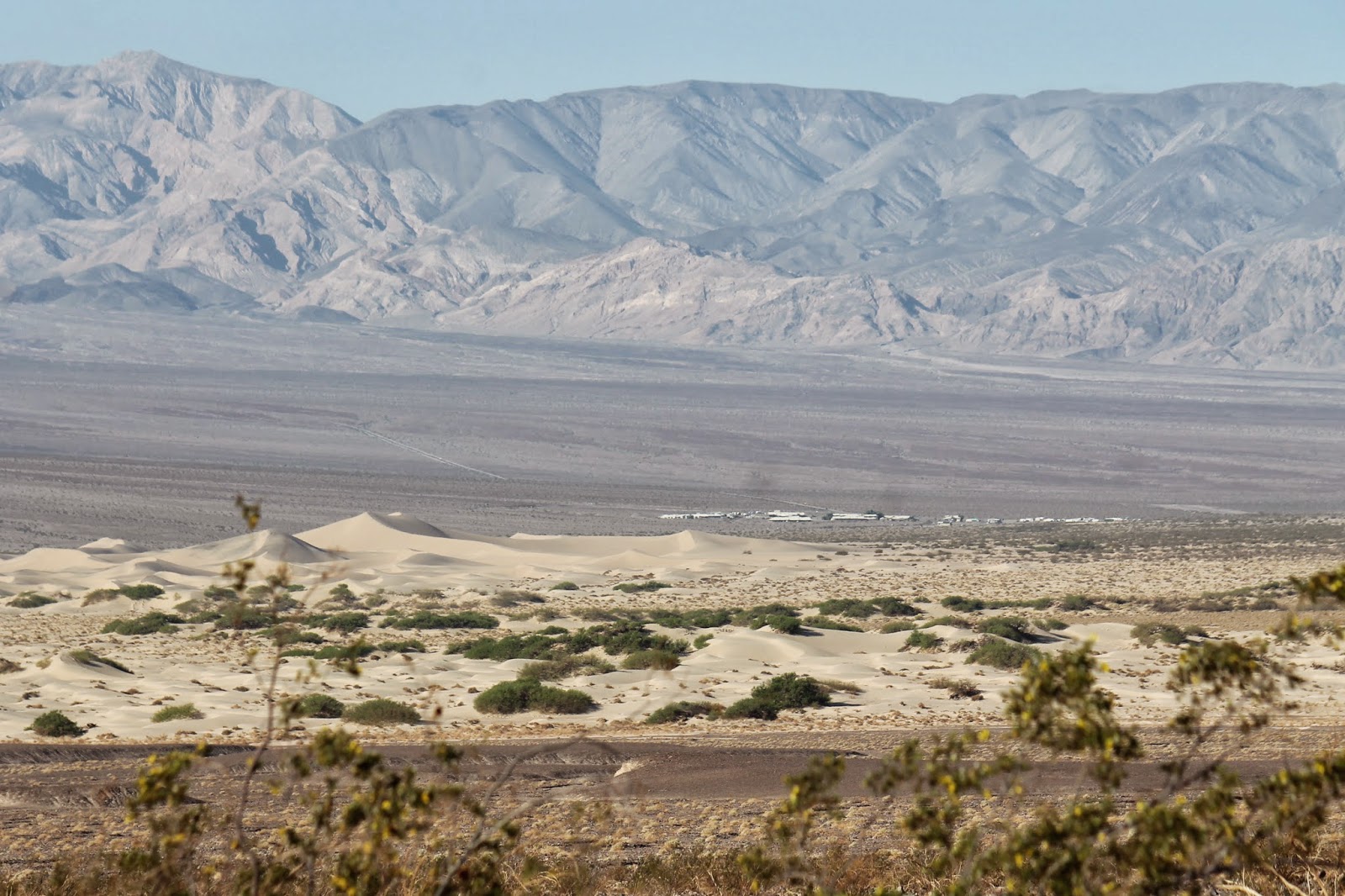 |
| We stayed at the settlement you see in the middle of this picture--Stovepipe Wells, founded in 1926. The owner built his own toll road into the valley for tourists. |
 |
| Scotty's castle was built at the site of a 250 gallons/minute spring that provided water and electric power for the house. When the railroad closed in 1934, the owner bought 200,000 railroad ties to use for firewood. |

 |
| Rangers in 30's period costumes give tours of the site |
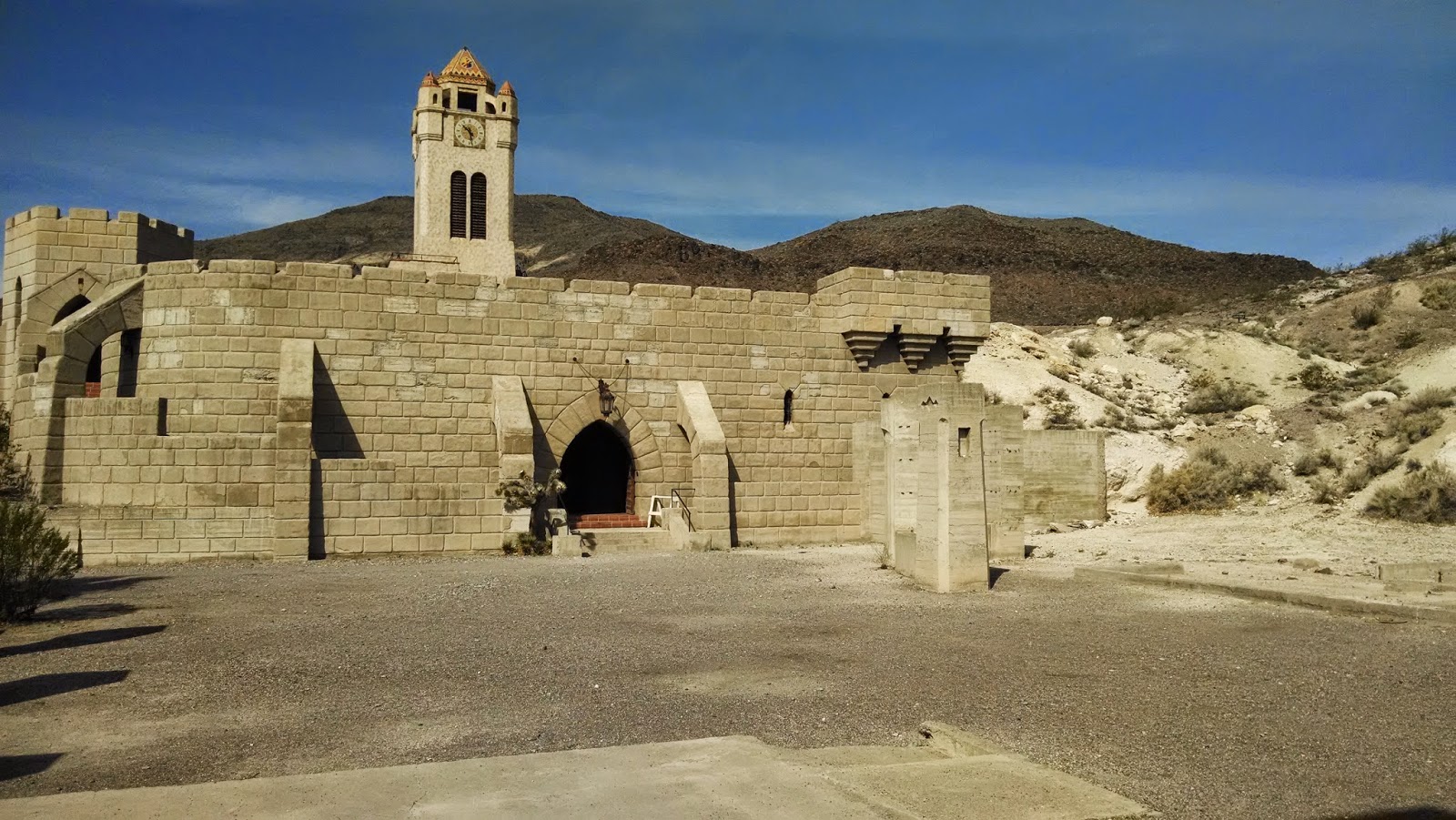 | ||||||
| This is the power house which was built 1n 1929 to house diesel generators to supplement the hydro power provided by the spring. The additional generators were needed to power the 1014-pipe organ brought in to provide music. |
 |
| The interior was decorated in Spanish style with no real concern for cost. Before the Depression, the owners' income was over $1 million per year. |
