Travels with Tucker

Travels with Tucker

Monday, March 31, 2014

Badwater--lowest place in the U.S.


The lowest point in the US is called Badwater.  It is 282 feet below sea level.  For miles around Badwater, there are salt flats, which mostly aren’t really flat and in some places are the most uneven and treacherous terrain I have ever tried to walk on!  Since there is no outlet to Death Valley, all the rainfall for thousands of years has washed minerals to the bottom where it evaporates.  The salt flats get hot in summer—ground temperatures of 180 degrees are common and it is not recommended to hike there in the hottest months.

The red arrow points to a "Sea Level" sign up on the cliff

Walking on the salt flats at Badwater


It really is salt...I tasted it

In the foreground you can see where people have trampled the salt crystals, beyond is the un-trampled salt flats that go on for miles

The salt forms intricate crystals


In this area, the salt forms a jagged surface that is almost impossible to walk on, colorfully called The Devil's Golfcourse for the tourists ;-)


Death Valley, geology classroom


Death Valley has been created by massive parallel uplifting plates that run North/South along the California/Nevada border.  10,000 years ago it was a lake and now it is one of the driest places on earth, getting an average of less than 2 inches of rain a year--some years it gets none.  Just 30 miles to the West, the Sierra Nevada mountains get 30 FEET of snow a year.  But as dry as DV is, the effects of water are everywhere.


I’ve never seen a place with so much erosion.  The mountains that line the valley are cracked with dozens (hundreds?)  of canyons that each have produced alluvial fans of rock and gravel that stretch for miles.  These canyons contain glaciers of rock that represent the pulverized remnants of the surrounding mountains.  The floor of the valley is filled 7,000 feet deep with eroded rock!  


Lynnae navigating Mosaic canyon
The canyons of Death Valley are amazing.  We walked up several and even drove through a few.  They are living geology lessons and more varied than one would believe possible.  Here are some highlight pictures of ones we visited.


Natural bridge down one of the canyons


There is even a place called the racetrack where the rocks slide by themselves.  We didn’t risk taking the tire-eating 26-mile dirt road safari to get there, so here is a picture, courtesy of that wonderful internet. No one has ever seen the rocks move but it is thought that after a rain, the surface mud gets so slick that the wind can blow the rocks around.  The Racetrack is a dry lake bed that is flatter than a billiard table--less than 1-1/2 inches variation over the whole 3-mile surface!

Sunday, March 30, 2014

Some history


I was surprised to find out that Death Valley was not made a national park until 1994. Before that it was a national monument, which didn’t give it the same level of protection.  Mining had been going on in DV since the early 1800’s and there are thousands of mine shafts in the park.  Modern intensive mining was starting to take a toll on DV until it was better regulated and now it is essentially stopped.  We visited four remnants of the mining period: Rhyolite, Leadsfield, Harmony Borax works and the Eureka gold mine.
 

Rhyolite was founded in 1904 and became a boomtown with thousands of residents and two banks. This is one of the bank buildings.
Rhyolite general store

Mill for processing gold ore at the Eureka mine.  This mine operated until 1945 and produced an estimated $175,000 worth of gold (at $20 per oz. at the time) for the man who owned it. Ironically he lived his whole life in a place where there was nowhere to spend his wealth!
Eureka mine entrance


In the 1920’s, some of the mining companies were visionary enough to realize that tourism would become the true gold of Death Valley.  Two competing lodges were opened, Stovepipe Wells and Furnace Creek Inn and Ranch.  They are still the main places to stay in the park either under a roof or in a tent.  We camped at both.
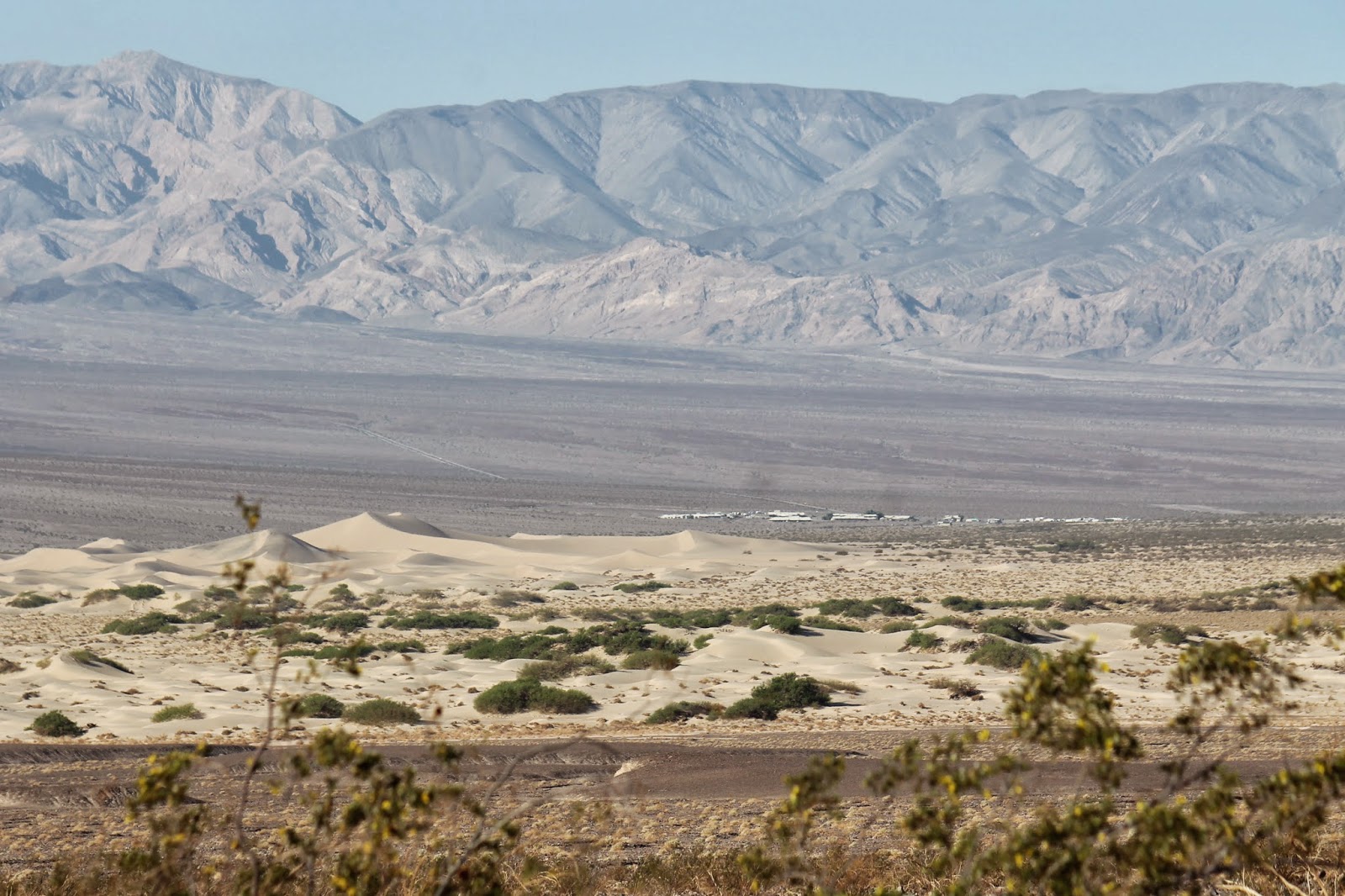
We stayed at the settlement you see in the middle of this picture--Stovepipe Wells, founded in 1926. The owner built his own toll road into the valley for tourists.
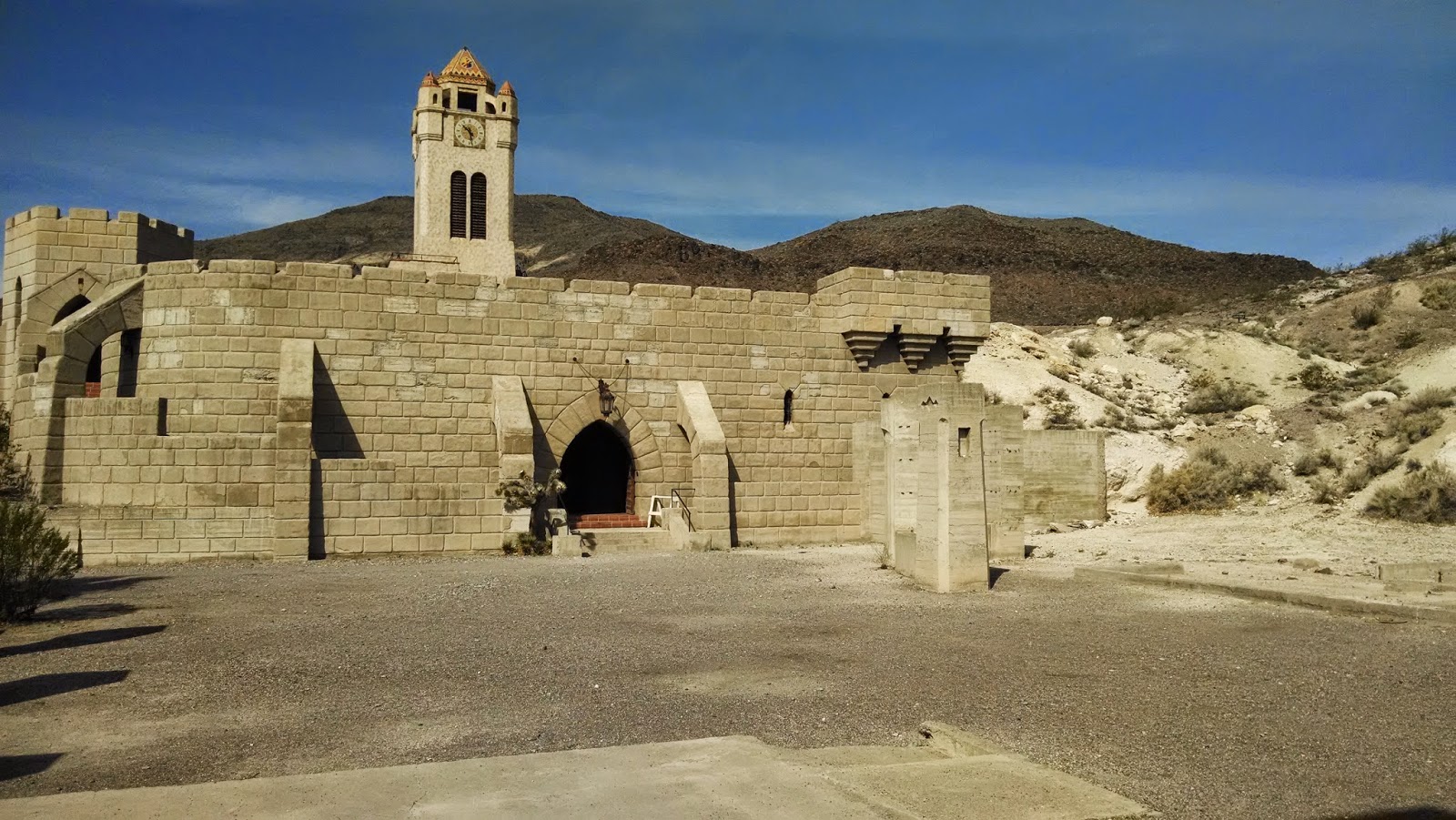
Also in the 1920’s a unique chapter of Death Valley resulted in the estate now called Scotty’s Castle.  This huge Spanish-style “vacation home” was built by a Chicago millionaire and his wife, but the star of the show was really Death Valley Scotty, who claimed to have built the mansion with riches he got from his gold mine.  People used to pay to stay at Scotty’s Castle and be entertained by Scotty’s tales of Death Valley, while the real owners of the home stayed in their own part of the house! The complex is an engineering wonder and a pioneering “green” home!
Scotty's castle was built at the site of a 250 gallons/minute spring that provided water and electric power for the house.  When the railroad closed in 1934, the owner bought 200,000 railroad ties to use for firewood.
Rangers in 30's period costumes give tours of the site

This is the power house which was built 1n 1929 to house diesel generators to supplement the hydro power provided by the spring.  The additional generators were needed to power the 1014-pipe organ brought in to provide music.

The interior was decorated in Spanish style with no real concern for cost.  Before the Depression, the owners' income was over $1 million per year.

Tuesday, March 18, 2014

Death Valley!

Lynnae and I lived in California for about a combined 89 years and neither of us had been to Death Valley.  Everyone our age grew up watching "Death Valley Days" with the 20-mule-team Borax ads and I had pictures in my mind of vast sand dunes and salt flats, but the reality of this place is beyond what I expected.  First of all, the scale is HUGE and with no trees anywhere, the vistas are spectacular.  The lowest spot in the world (289 feet below sea level) surrounded by 11,000 foot mountains and a place where the skeleton of the earth is laid bare and the geologic processes are exposed like nowhere I have ever been.  As I write this, we've been in DV for a week (without internet, I should add), and I will get some blog posts done (probably after we leave the valley) that show some of the wonders we have seen.


Sand dunes with mountains behind--at sunset


Lynnae hiking a typical slot canyon in DV.  As you will see, some are so smooth you can drive through them!

Sunday, March 16, 2014

One more stop in Palm Springs

We had to attend to some medical appointments back in Palm Springs (thanks, Obamacare!) so we rented a space for a week at the Outdoor Resort, which was WAY more upscale than where we had been staying all winter (the Happy Traveler) and more upscale than our usual style.  It was fun and very comfortable and we met some nice people who come back here every year.

Outdoor Resort near Palm Springs

We also visited the Living Desert Zoo, which was pretty interesting.  The landscape design was fabulous and the grounds were beautiful, but zoos are always a little bit sad and this one was no exception.  It did have what must be the world's largest train set and some beautiful cats that did tricks.


We are off for Death Valley National park and very excited to visit there for the first time for both of us.  Here is a picture of a tourist trap in the desert on the way and of us stopped on the road leading into the park.

Tucker checking out the Mad Greek's sign

Not a lot of traffic headed to DV! You might just be able to see the yellow wildflowers.

Saturday, March 8, 2014

Taking the train to San Diego

The Coaster commuter rail goes along the coast from Oceanside right into Old Town. We decided to take a train ride on our last day (for now, we'll be back!).

Monday, March 3, 2014

San Clemente

Once jokingly called "San Clemency" in honor of ex-president Nixon who lived here, San Clemente is a sparkling beach town where everyone seems to surf and the fish tacos are plentiful. We are here for a week of beach and laundry hopefully some good bike riding. The weather promises to be cool but dry and we can once again see the Pacific from our living room.  Our friends Janet and Jim from Plymouth are going to visit us here and that will be a treat.